How to Bridge the Digital Divide with Broken Computers

Posted on: January 17, 2013 at 8:15am — By: Julia


Earl Kaplan stands near a wood table scattered with assorted screwdrivers and a package of oatmeal cookies. He surveys the half-a-dozen other retirees, each one tinkering with a computer in various states of repair.

From across the small workshop, someone heckles Earl about the stress that comes with his job.

“I give ulcers; I don’t get them,” he says with mock sternness. “It’s better to give than to receive.”

There’s a palpable air of cheerfulness in the backrooms of The Exploration Station, a youth science museum and technology center in Grover Beach, California. Computer towers stand with their guts exposed; PC fans hum placidly; the refurbishers cajole each other lightheartedly. One computer lets out a long, impatient beep. Earl glares at it.

“Tell her about our lunch,” one man shouts over his shoulder.

“Oh! Our annual lunch? Our annual no-host lunch,” Earl says. “Once a year, we go out to Round Table Pizza and we vote ourselves a percentage raise.”

Everyone laughs. The joke, of course, is that a percentage raise of zero is still zero. Earl and company are unpaid volunteers—part of the 25 regular volunteers that keep The Exploration Station running. Almost all the volunteers are retired. Some have been donating their time here for more than a decade.

But the work is rewarding. Most of the volunteers at The Exploration Station collect, recycle, and refurbish computers as part of the organization’s Computers 4 Youth program. The goal: get technology into the hands of those who need it—and do it for free.

“People need computers,” says Deborah Love, the Exploration Station’s director. “We underestimated [the degree of need], because as computers started becoming cheaper and more user-friendly, we did anticipate that the need would taper off. It has not.”

Across the digital divide

Apple sold 237 million iPods, iPads, Macs, and other devices from January to September of last year. In 2005, US households threw away 304 million electronic devices, including computers; two-thirds of those devices still worked. But computers aren’t nearly as ubiquitous as they seem—at least, not for everyone. Here’s where abundance butts heads with scarcity: 46% of the poorest households in America still don’t own a home computer.

Smartphones fill the gap for some people—about 40% of people in that same income bracket say they primarily go online on their phones—but it’s not quite the same. Students struggle to write an essay on a smartphone. Seniors usually learn to navigate the web on computers, not cell phones. Have you ever tried formatting a resumé on a phone? Plus, most jobs these days require basic computer skills and internet competency; Americans in the digital red often have trouble finding jobs. Getting computers into the hands of more people who need them is the first step towards bridging the information and communication technologies gap.

Over the last 14 years, The Exploration Station and Computers 4 Youth have given out nearly 4,000 computers across two neighboring counties—and not just to kids. They’ll give a free computer to anyone who really needs one.

“There is such a need with seniors, veterans, people re-entering the workplace,” Deborah says as Doris Gutierrez, a program administrator, flips through files containing the names of people on the waiting list. Currently, it’s about 40 names deep. “As they come in, we just line them up and that’s how we get them their computers,” Deborah adds.

And while the need it great, Deborah seems confident that every single person on that list will get a computer. It’s a struggle, but they’ve always been able to fill their orders, no matter how big (last year, they gave 30 computers to a local church hosting computer classes for the community). And they’ve always been able to do it on a budget of practically nothing.

How waste can fight want

Computers arrive at The Exploration Station because they’ve outlived their usefulness. Some unwanted, used computers are donated to the program by local families and businesses. Others come to the facility as e-waste. The Exploration Station is a state licensed e-waste collection site. Behind the building, volunteers welcome people with drop-offs and sort through the cast-off electronics. Old and broken computers are separated from the pile for dismantling or refurbishing.

“A lot of times, we get computers in that are fairly new,” says Earl. “You wonder why someone threw them away. And sometimes we’ll find out there’s a bad power supply on it, and we put a new power supply in. We’ve got tons of power supplies.”

Refurbishing is how broken becomes new again. Nothing goes to waste. Even an unrepairable PC will have some salvageable components in it. Everything else is recycled. Of course, it helps that PCs are relatively easy to open and take apart—no need for spudgers or pentalobe screwdrivers. They have an iFixit Bit Driver Kit, but they rarely have to use it.

“Almost everything can be done with one of these,” says a volunteer, thrusting an old Phillips screwdriver into the air.

On a good day, the volunteers can refurbish as many as 10 computers. Then, each gets a new operating system, open-source software, and some educational games. After that, it goes to a new home.

Final cost of refurbishment to The Exploration Station: Zero dollars, zero cents. But, to the recipient, a refurbished computer means so much more—it’s a gateway to information, to education, and to the workplace.

That feeling of gratification is why the volunteers at The Exploration Station do what they do—and why they do it cheerfully. Each computer they refurbish is one fewer sent to a landfill. Each computer they give away will make someone’s life just a little bit better.
Deborah stands in the lobby of The Exploration Station. In front of her, interactive science exhibits dot the room. Giant models of Saturn and Jupiter hang from the ceiling. Down the hall, a volunteer teaches a young woman how to use her new computer. Deborah smiles.

“We’re very happy to be doing what we’re doing.”

Edit on January 30: A previous version of this article mistakenly stated that 304 million tons of electronics were thrown away in 2005, instead of 304 million electronics. Our apologies; thank you to a careful reader who noticed the error.

Comments

Back in the day at Nortel, a group of similar “old guys” asked if they could recycle old phone switches, to retrieve the Gold (Or) in the connectors. Evidently the project paid for itself many times over just in salvaged precious metals (there was platinum in there too).

By: Big Cajun Man - January 18, 2013 at 7:14 am

Great story!

By: Steven - January 21, 2013 at 9:52 am

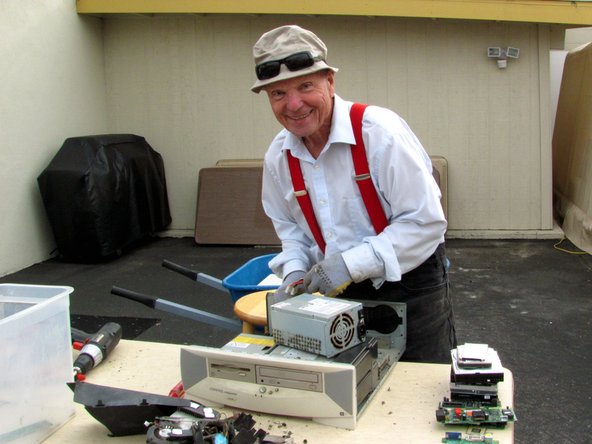
The photo that starts this post is actually that of John Ehrenborg, one of our loyal and dedicated colleagues. John works at his outdoor table in all but the vilest weather and converts unusable PCs to material with some salvage value.

By: Earl Kaplan - January 26, 2013 at 8:57 am

ROCK STARS!

By: richard Luttrell - January 30, 2013 at 1:44 pm

Is there such an organization in Sacramento?

By: Carl Di Stefano - January 30, 2013 at 1:50 pm

would be great if there was a list of groups like that all over the country.

By: Achim Franz - January 30, 2013 at 1:54 pm

I’ve been finding, fixing and giving away Apple Mac computers since I retired in early 2002. More than 800 Macs have gone to new users in schools, homes and similar places such as churches and non-profits in the greater Eureka, CA area and Humboldt County. I’ve also donated countless hours of pro bono tech support to local schools. The grade school computer lab down the street has been upgraded three times by my Macs for Kids. It currently sports 31 eMacs, of which I contributed 27 and repaired/rebuilt one of the four bought by the school. Wish I could say it all has cost nothing, but the sad fact is that cleaning supplies, gasoline, clock batteries, replacement parts like hard drives and optical drives, keyboards and mice, etc., as well as complete Macs have to be purchased to move things along in this rural county. However, I’ve managed to sustain the giveaway side of my hobby by fixing and selling newer Macs. But nothing is as rewarding as the happy faces of kids using their new-to-them Macs. Sure beats trudging around a golf course. :^)

By: Jim Scott - January 30, 2013 at 2:10 pm

Wow what a fantastic team keep up the good work, One man’s trash is another man’s treasure

well done God Bless

warm regards Mark

By: mark wheatley - January 30, 2013 at 2:25 pm

I took apart an ’06 or ’07 MacBook, using iFixit, in order to remove the logic board. I’d like to donate it, still disassembled, without a working logic board to a similar group or individual in the Atlanta area. I’m 70 w very little computer experience, and while I am glad I did it, I would rather buy a refurbished MacBook (13″ aluminum – crave the aluminum!). Anyone nearby? Thanks!

By: Liz Hill - January 30, 2013 at 2:43 pm

I am glad to see so much gray hair in your organization, I am a 72 year old guy that loves to refurbish the iPhones and an ocasional PC but my enjoyment comes from the iPhone rebuild.
I use your tutorial\s on a regular basis and find them most informative,especially when I tear down for the first time!
I have been working with computer repair since the mid eighties my close friend that got me interested was a network engineer for Dell. (I do it just as a hobby).
My business before retirement was restoration of old Rolls Royce and Jaguar sport cars,(only british).
Anyway Thank You for all of the info you provide in the electronics field and please continue, your service is most valuable
Tom

By: T Ashbarry - January 30, 2013 at 2:52 pm

wonderfull site…IFIXIT..
good work…good for every body..
we can learn more from your site…
god bless you.. riyaz

from spain

By: riyaz - January 30, 2013 at 2:54 pm

Love you guys! We work in an Urban Boston school and want to help too.

By: tim archibald - January 30, 2013 at 3:05 pm

There’s little reason to buy a new electronic device, a lot of old technology is still adequate.
It is unfortunate that the world’s economy is based on perpetual consumption of the newest, flashiest, technologies of which causes perfectly good and still useful consumer electronic devices/equipment to be junked. If the world continues that way we are doomed. Reuse, upgradeability (including laptops which aren’t currently) and consumer education are parts of the solution.

I have never purchased a new computer, router, ipod, digital camera, etc. I resurrect computers and other consumer electronics I find in the garbage and either use them, give them away or take them to a certified recycling facility. Sometimes I purchase a second-hand or refurbished electronic device if I need something that I can’t find discarded. As well, a lot of unwanted equipment was top-of-the-line which can be found or cheaply purchased. I don’t have a flat screen TV, I am using a 36″ Proscan CRT TV I bought second hand for $100 5 years ago. I am still using my over 30 year old Yamaha CR2020 stereo receiver. I am using a 2nd generation iPod I got from one of my sons a few years ago. I am using second hand WRT54G routers which I’ve put Linux software on and used them to create a mesh network. Etc., etc., etc. I bought a second hand digital still camera for $75 that originally cost $500 and a 3 CMOS sensor video camera that originally cost $1200. I’ve kept my 35 year old Maytag dishwasher going too by repairing it myself and I have the best toaster ever made which is 40 years old, a Sunbeam T-40 Radiant Control, which I got at the Goodwill for $5 and fixed it by learning how to adjust it to work properly from information I got on the internet. I drive a 10 year old car which I look after well and do as much as I can myself so that I don’t have to spend lots of $ on maintenance and repairs. Recently, it needed something installed and I traded something to the mechanic for his work.

I also help others to keep their old stuff working and, if they don’t want it, I get it to use, give away, recycle. Near where I live, there’s a second hand electronic store which sells discarded computers, etc., and sells parts which have been stripped out of defunct equipment. I’ve donated quite a bit of stuff there which the owner sells and keeps his store open to continue what it does.

I grew up poor and learned the value of a dollar, that it isn’t easy to earn and everyone wants to get it away from you and that every hour spent working to earn money is an hour less of life one has to do what they want to do unless earning money by doing what one wants to do which few do. Because of that, I haven’t bought into the consumer society, I’ve been able to save up enough money to retire early and not worry about how much I spend and that I will outlive my ability to finance my living. I suppose that, because of my anti-consumerism behaviour, I’m part of the reason the world’s economy is stagnant.

By: Brian - January 30, 2013 at 3:08 pm

Thanks for email me about this proyect .Really is fantastic help the people.Is very big opportunity learn something different.Is in this way we can do something for our enviromental too.I wolud like be part from this proyect/.Thank you again and God bless every one.

By: Manuel - January 30, 2013 at 3:32 pm

Hey: I want in on this fun. Anything available in the Torrance Ca. area?

By: nate almond - January 30, 2013 at 4:59 pm

Thanks for such an uplifting article; I live in Grover Beach, just a few blocks from the Exploration Station and have been there many times to view the facility which is a wonder for people of all ages and to drop off contributions to assist these wonderful men with there work.

By: Bill Compton - January 30, 2013 at 6:00 pm

Very admireable !
Keep the good work the world is a better place because of your dedication.
Far too much stuff is thrown away today by people who never had hard times , and in many cases just arn’t capable.
I fix whatever I can or try to find someone to help.
When I was a teenager (I’m 87 now) I had an old violin and took lessons etc…well years later after marriage and kids and working at my business and supporting a family … I retired and finding my old fiddle , that had fallen apart due to humidity changes etc .. I tried to find someone to fix it at a reasonable cost , but that didn’t work out ,so I decided to learn how they were made ..some on Internet and books etc , sand decided that I could take a shot at it myself … After about a year ,it all came together and when done it became a pretty violin ( a copy of a very old Italian model… Well to shorten this , I decided to make another and so forth, an ended up with 10 instruments … And some people have sai were quite good.. So as a hobby it worked out great , because there is a lot more to it than meets the eye , and it helps in my casE as I love the classics and play as well, so, as long as you are in reasonable health you will find that a hobby of fixin things will keep your brain and body Young I

By: John Young - January 30, 2013 at 6:59 pm

I live in the midst of Appalachia. I’ve been a Mac guy since 1983 when a boss I had brought in a Mac 124 K and plunked it on my desk.
I’ve always bee the go to guy for the 15 Macs in my office and my own Macs – sometimes three at a time.

How can I begin a project like this?

By: Dave Gustafson - January 30, 2013 at 8:17 pm

Good work guys! I am a retired HS teacher who for the last 11 years has refurbished Macs from schools and businesses and donated them to needy folks. I’m not part of a group and work at home in my workshop. My macs, around 500 so far, have gone to individuals and organisations both here in Western Australia, Africa and Bali, Indonesia.

By: Kevin Lock - January 30, 2013 at 9:14 pm

I look at every thing you guys can do you must be really good mate, you work together as one, I’m in Australia so I can’t join you guys but I like to
Have a great day Mates.
Ian

By: Ian - January 30, 2013 at 9:15 pm

so encouraging to hear this! As is said in a previous share, I would love to see some sort of site where one could find locations like this around the country. it’s true, that if one doesnt know how to fix it, an even slightly broken computer is no good- so cool that someone with the knowledge can give it to someone that needs it! Would also love to see a facebook like link on this site so that I could like it and share the info with all my facebook friends- could be useful all across the board.

By: Kristin Killion - January 31, 2013 at 3:22 am

In the Toledo area there are several places that recycle computers… I am not sure what the end result of the recycling, would you like me to bring ifixit.org to their attention?

By: Douglas Dinnebeil - January 31, 2013 at 5:39 am

Nice story, we need more of them in our society!

By: Francois Rodrigue - January 31, 2013 at 6:39 am

i love the ifixit site
i keep a copy of the manifesto and the top of my workstation because what you are doing is important
just awesome what this group of people are doing with the ‘garbage’ electronics
very admirable…you guys rock!
cheers from toronto, ontario, canada

By: sonia di maio - January 31, 2013 at 6:56 am

I want to replicate this in my country.Can you guide and provide the equipment and tools required to provide retired persons a way out.

Await response

Yours sincerely

Mohammed Waseem

By: Mohammed Waseem - January 31, 2013 at 8:14 am

I would like info pertaining to this endeavor I could use to start such a venture in the Gig Harbor area in WA State. How did you go about setting up the old electronics recycling site? ~ drh

By: Dennis Hamling - January 31, 2013 at 3:48 pm

Awesome story!

Thanks for sharing such a positive and rewarding concept and story. One mans trash is another mans treasure…with a little help. I’d like to send out a special thank you to the Exploration Station Team. What a way to pay it forward and to give back once again to the younger generation.

Best regards,
John Brixen

By: John Brixen - January 31, 2013 at 4:06 pm

Hi there Dennis,

Thanks for your feedback. The world could certainly use a few more Exploration Stations. For more information on how they started up the program, you should probably contact the program directly at info@explorationstation.org. Here’s more details about the program: http://explorationstation.org/computers-4-youth/

By: julia - January 31, 2013 at 4:16 pm

A great program! Congratulations. This will be a good project for Germany too.

By: Annette - February 1, 2013 at 4:27 am

So, if I wanted to get something like this started in my little city – and I do – what kinds of tools do I need and/or would be helpful to test various components?

Thanks,

Janice

By: Janice Best - February 4, 2013 at 11:23 am

I am one of the old guys in the Exploration Station and have been there since we began in 2001.

We began this work with just a few donated computers and now we have many more available to refurbish. We are a Microsoft Registered Refurbisher, and pay a small fee to them for each Windows license.

We have several jobs in the Computers-4-Youth (C4Y) program:
1) Screen donated machines to make sure they meet our specs.
2) Refurbish computers, rebuilding one in 1 hour to 3 days depending on problems encountered, sometimes dumping one and starting over.
3) “Kitting” a completed computer with monitor, keyboard, mouse, speakers.
4) Processing applications for computers and making appointments. Applicants must be recommended by an “agent”, usually a social worker, counselor, teacher, etc. and the computer received must be the only one in the home and the person must not be able to afford one to get one of C4Y’s.
5) Presentation. Some are just picked up, but often the recipient needs orientation. We offer a demonstration, 15-45 minutes where the recipient and often his/her parents or a friend learn what’s on the computer, how to use it, and where to get more help.

We have approximately 25 volunteers every Wednesday, and present about 8 to 10 computers each week.

To begin a program like this you’ll need several savvy PC folks who can create a Windows image and possibly add other applications and then show others how to put this image on a system for the recipient, find drivers, and thoroughly test the unit. These experienced geeks will need to be nearby to answer questions and make sure the rebuild instructions and tests are followed.

This may shock some, but some donations have unusual and hard to find problems or may not function at all! We will repair the recipient’s computer free for a reasonable time as long as it has not been damaged. If it has viruses or spyware our repair is limited to re-imaging the hard drive so it’s restored to the way they got it from us and we will do that only once — we warned them, fixed it once, and after that it’s a doorstop. We have about 3500 machines out there and it’s a wonder we don’t repair more…

All of this requires screening and training of volunteers as well. Many of us have been there for many years and we have a pretty good time each week. Each year at Christmastime we have a gourmet luncheon (no host pizza), grant ourselves a 20% raise for the next year, and take about 3 weeks off.

Dave

By: Dave McLaughlin - February 4, 2013 at 1:19 pm

I’m one of two vocational instructors at the ABC Adult School, Cerritos CA, teaching computer repair. At the school we receive computer donations from the public and refurbish them for students at the school who are in various State re-training programs. Also are advanced computer A+ training program
refurbishes laptops for students.

By: Mike Normoyle - February 4, 2013 at 8:30 pm

Comments are closed