Unfixable Computers Are Leading Humanity Down a Perilous Path

Posted on: June 22, 2012 at 11:44am — By: Kyle

This article originally ran with Wired.

I’ve been writing about Apple and the value of repair for the better part of the last decade. Repair is our mission at iFixit — and it always has been. Even so, I didn’t expect the scale of the public response when I argued last week that consumers should choose the hackable, fixable non-Retina MacBook Pro over its sleeker-and-shinier-but-locked-down sibling.

The debate has been contentious. Garrett Murray argues that repairability is ludditism, old-fashioned inertia dragging down forward progress. He believes that more compact devices will necessarily be less upgradeable and hackable.

Others said repair doesn’t matter; consumers don’t care. On some level, they’re right. If something breaks, most computer owners won’t grab a screwdriver — they’ll take it to a specialist. And if the computer outlives its usefulness, they won’t upgrade their machine, they’ll just buy a faster one. Some folks correctly pointed out that Apple products are more durable than other computers. Plus, Apple has a reputable extended warranty program.

But sending your difficult-to-repair computer off to a Genius doesn’t exempt you from repair troubles. About a third of computers break by the fourth year. AppleCare doesn’t cover accidents and only lasts up to three years. Less repairable design guarantees that fixing stuff will be more expensive and complicated. Repairability is important for consumers.

Yet I think this argument misses the bigger point. The future of this planet depends on the quality of our electronic devices — and how long they last.

Technology doesn’t just make our lives more convenient. It makes life better on a global scale. Modern communications have driven advances in biotechnologysoil science, and medicine. For the first time,farmers are able to get instant weather advisories, pay for fertilizer by phone while standing in the field, and fight back against local monopolies with access to global commodity prices. Globally, we manufactured 1.6 billion cell phones last year, and we’ll make over 2 billion this year. The problem? The way we’re doing it hurts people and permanently damages our environment.
I dream of a sustainable technology industry that makes life-changing innovations like the iPad available to everyone on the planet. But I have a message for Jonathan Ive. I think that on top of building amazing new products, the technology industry should have three goals:

I’ve spent a lot of time studying these problems. I’ve visited the electronics scrapyards in Ghana where children burn electronics to mine them for raw materials. I’ve interviewed product designers at leading electronics manufacturers, including ones that integrate life cycle analysis into their design process. And I’ve spent a lot of time studying the aftermarket — the raw underbelly of the consumer electronics industry, where repair, reuse, and material recovery happen.

There’s no such thing as a completely green cell phone or computer. Even elective ‘green’ standards like EPEAT are far from mandating environmentally neutral products. I’m on the EPEAT balloting committee, and chemical companies have successfully lobbied for years to water down standards — much to the chagrin of everyone, including many manufacturers.

I’ve learned that most of the environmental and social impact of the electronics industry happens outside of the purview of the device manufacturers: It happens in mines and chemical factories well upstream of Foxconn and in unregulated scrapyards around the world.

Pit mining is savaging the environment, causing water pollution issues that lead to birth defects and are unbelievably expensive to clean up. Semiconductor manufacturers’ insatiable demand for a vast array of minerals is also causing geopolitical issues. China is heavily restricting exports of rare earth metals to prop up its domestic manufacturing sector.

When the warranty ends, manufacturers would prefer it if stuff disappeared so they could sell you a new product. But the real world isn’t nearly so tidy. Only a small fraction of the electronics produced are recycled. And even then, they’re usually shredded and separated into component materials. Shredding is a waste of resources and squanders the embodied energy in devices. Worse, many materials, including rare earths and coltan, are not being recovered at all.

So, why do we keep making more devices? We’re pretty close to manufacturing almost all of the electronics we need. There’s no need to make a billion more cell phones next year than we did this year. Increased manufacturing isn’t just due to advances in technology — we’re not very efficient at utilizing things that we already make. If you don’t have at least one cell phone in your junk drawer, I bet someone in your family does. That phone could be helping someone else.

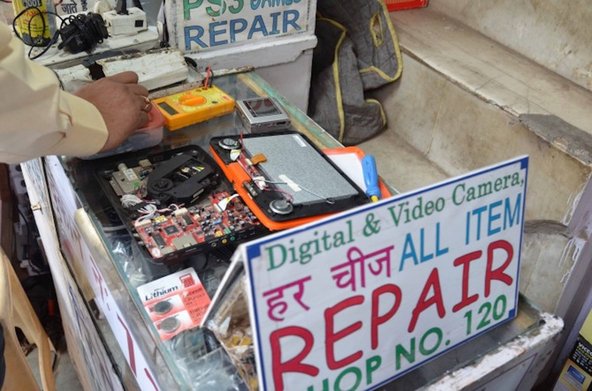
In an ideal world, after you’ve moved on to your next gadget, technicians will continue to repair, salvage, and refurbish the old one. It will move on from owner to owner. iFixit is part of that ecosystem — in addition to teaching repair, we buy computers from people and resell the components. I once received a computer with a handwritten note on it: “Goodbye, iBook. In your death, may you give life to a dozen more computers.”

And that’s my hope for electronics everywhere. Fortunately, the migration of usable electronics to the developing world is natural. Lots of people can’t afford to buy new computers. Passing along old devices is the best way to share the benefits of technology. In a few years, the computer that you gave to Goodwill could very well end up in a computer lab in Kenya. I know electronics refurbishers that have resold the exact same computer six or seven times. And assuming repair techs have the knowledge and skill required to maintain them, those computers will serve their owners well, costing less each time they’re passed along.

Long-lasting, repairable hardware is the key to making computers available to people who couldn’t otherwise afford them. Upgradeable tech also helps — even if you don’t upgrade your own computer, somebody else down the line can. It’s amazing how long people can keep technology running.

Manufacturing electronics results in lots of nasty environmental problems, everything from toxic dumping to aldehyde vapor emissions. We have decided, if only by inaction, that the cost of our hyper-productive modern lifestyle is worth these tradeoffs. I’m culpable myself — I live at the cutting edge along with all of you.

But if we’re going to make that tradeoff, the least we could do is to pass on the technology we’re enjoying now. That’s why I am so eager to promote hardware that lasts and call out products that don’t. It’s critically important that we fix things when they break. Consumers need to demand products that aren’t just light and thin, but can also stand the test of time. Because technology is far more than just another new gadget — it’s our future.

Comments

“If you don’t have at least one cell phone in your junk drawer, I bet someone in your family does. That phone could be helping someone else.”

Unless if its a phone that is obsoleted by constantly evolving telecommunications standards. Many cell phones made as little as seven years ago simply will not work any longer due to shifting standards. The telecom industry is prone to this trait of inherited obsolescence… the computer industry is also prone in its own way, due to constantly evolving PC requirements dictated by the operating system.

It is not repair… it is pre-engineered upgradability and recyclability that will reduce eco-waste.

A good article, one that should spark debate, and hopefully, action.

By: Steve Warnek - June 22, 2012 at 12:01 pm

Dear Steve Warnek,
I used the same Motorola Timeport for 10 years and then I got a HTC smartphone. The Motorola still works perfectly (13 yrs now in constant use) and I use it for foreign guests and as my extra phone.

Been using the HTC for three years now, see no reason to change until (if) it wears out.

By: Lilly Hunter (@LillyLyle) - June 22, 2012 at 12:09 pm

I actually trashpicked a older HP tower and heavily upgraded it from what it was

it had 256MB RAM, 40GB HDD. modem

It now has 512MB RAM. 100GB HDD, ethernet card and wireless

The simple actions of upgrading the hard drive and memory were enough to give this computer many more years of service in the end, and it was doomed to be in the landfill

Well worth the trouble, I am actually using this HP to write this comment right now…….

By: Nick - June 22, 2012 at 3:26 pm

Hi Kyle,

I have a question. Is it really viable economically for someone in the third world to repair ANY laptop?

Could you go through the actual costs of spare parts – new batteries (I suppose used batteries are no good and actually dangerous), screen, motherboard, RAM, hard drive (and SSDs for newer models) etc for common repairs on laptops?

I have this nagging thought that replacing any of these is too costly.

Also, say you have two retina MBPs broken in different ways, e.g. one dead battery and one broken screen. Would it be possible to transform them into one functional machine?

Thanks

By: Gkpm - June 23, 2012 at 9:37 am

Just about anything is recyclable and by the who’s business is it anyway what I do with my equipment that is no longer usable. Take leaded solder for example: it is a much better solder for electronics and plumbing than the crap they uses today. I am glad I have a lifetime supply of solder that works well and has a longer lifetime of reliable use than the alternative that is being shoved down are throat by do gooders who do not know what they are doing.

By: George Van Houten - June 23, 2012 at 7:40 pm

Re: Gkpm. It’s pretty impressive how capable they are. I have friends that will replace the integrated graphics BGA chips, and I know people that can swap out a bad USB port. They’re quite successful with surprisingly little documentation.

We have all the parts prices for Apple products listed on our Mac parts store, so you can see specifics there. Usually, the screen and logic board are most expensive, then the battery, hard drive and RAM.

If you had two retina MBPs broken in the ways that you mention, you absolutely could combine them together to make a complete unit. The battery is integrated into the upper case assembly, so the entire thing (keyboard, trackpad, battery) would need to be functional.

By: Kyle - June 24, 2012 at 3:51 pm

Dear Kyle I’m completely agree with you, repair is recycling! Thanks for your article!

By: Roberto Innocenti - June 25, 2012 at 2:16 am

“I’ve learned that most of the environmental and social impact of the electronics industry happens outside of the purview of the device manufacturers: It happens in mines and chemical factories well upstream of Foxconn and in unregulated scrapyards around the world.”

Your quote here says in all. Thanks

By: Bill Davis - June 25, 2012 at 7:47 am

I used iFixIt to fix my own cracked iPhone 4s screen. More, I started a new approach that follows the repairable model, at least for myself. So for example, I am not going to use an Apple dealer to fix my MBA’s battery.

To do all this, I had to make a decision: am I, at the tender age of 70 but with a 40 year career in computing, going to be responsible for liking smaller, lighter computers, phones and tablets? After a few days looking at iFixIt and other YouTube tutorials, I decided “Yes indeed, it even looks fun!”.

So I went big-time: bought the seriously professional iFixIt tool set, bought a 2.5X visor magnifier, bought the iPhone screen and started in slowly performing the fix. I admit that at times I thought I was nuts. After all, the screen is just about the hardest repare you can make! You literally take the phone COMPLETELY appart, from the back to the screen!

But it did work. Now I’m ordering a MBA battery and going after it.

BTW, iFixIt and others (iCracked) will recycle your old phones (phones for GIs) and parts, just as HP will refurbish inkjet cartridges.

You should try it .. and you also in the long run save a bundle!

By: Owen Densmore - June 25, 2012 at 9:35 am

Hi,

My self named nickname is Thinker tinker because I like to repair and give a new life to computers and others tech. I want to tell something bad about Apple and there vision of repairing old Mac.

Last month, I called a guy who posted an add to sell a defective mid 2006 iMac. I tell the guy “what’s up with the iMac?” the guy told me that he bring the computer to a Genius and this one tell him the trouble is a defective logicboard. The guy says the symptoms was kernel panic a boot. The Genius tell him the price is arround 100$ for a complete diagnosis. After that, Genius says “why you just not buy a new Mac?”. It the choice that guy and many others faces when they going to Apple Store for a diagnosis. They came back with a new computer which cost 10x higher than most reparations on a old Mac.

Take back the Mac to my house, plug it to wall and boot it. Kernel panic. Do a pram reset – boot normally. This Mac pass all AHT tests.

It’s the 29th Mac I saved from the dump. I’m sad that Apple doing this way of not helping people to keep there old Mac for a lower fee than 100$. Please proud owners of Mac, be wise and Aware try to repair your Mac before to spend several dollars in a Apple Store. Go to ifixit.com and see how it’s beautifull to repair computers and devices.

To conclude this, I think Apple since the first Macbook Air have a pathologic anorexic mind of what computing should look. They cannibalize the openness of what Apple was (easely reparable) in 2000-2007 to the profit of non-upgradable and hardly reperable. Just this to push the image of what should the ideal laptop.

Just to site a example : how it’s cute and nice the iPod touch 4th? This device is hard to repair because is easy to break the device just when open it without a heatgun. The iPhone 3GS it’s easy to repair to compare because the device have screws to remove to open it. Apple designer remove all the stuff who give peoples the choice to do a repair by it serf just by removing screws from the device enclosure. Hey they give use glue instead! Thank you Apple, anorexic mind corporate! You cut the choice of the customer again and this will be bad for the nature.

By: Eric Bertrand - June 26, 2012 at 9:17 pm

Hello,
I couldn’t agree with you more – thank you for writing these articles. I was originally hyped about the new retina macbook pro, and then once I read a couple articles on the low fixability, I changed my mind and have ordered one of the updated old design versions. We need to find a way to continue making new technological devices without such a cost to the planet, and we need to start using our devices for longer.

By: Brian D. - June 27, 2012 at 6:08 am

Remove the $$$ out of the equation, and incentive will shift toward longevity and quality.

By: Passing By - June 27, 2012 at 12:41 pm

I can’t agree more with you. There is a need to make people understand that a 1 or 2 year old computer does not mean it is outdated and does not work anymore and that you “have” to buy an upgraded version. I blame it in the fast pace of computer manufacturing and the ignorance in people not knowing that from 2.66 Ghz to 3 Ghz there is not that much difference and they have to wait for the next model that pushes the limits if they really want to see a difference in speed.
A good example of recycling a system: the daughter of a friend of mine asked me where she could properly dispose of her old Apple (2008 white MacBook). I asked what was wrong with it and she stated it was the hard drive but it will cost her $250 to have Apple fix it plus parts. I asked if I could have it and she brought it to me. I spent $160 for a new HDD and RAM to upgrade to 2 GB max and it has been working like a charm. Dual booted that puppy and now I have Windows and Mac on it.
It is the ignorance that has been bestowed upon the common consumer to think they have something slow or outdated and they need to replace instead of fixing.

By: George - June 28, 2012 at 7:22 am

You make a strong point that I agree with, unfortunately the technology industry, for the most part, will continue to produce products that are not easily fixed or upgraded. As you know the reason is economic and they make a good point also; business is business. I’ve been fixing and upgrading most of my computers and tech equipment for the past 15 years. From Mac to PC and all around to my growing inventory of audio equipment that I rely on for earning an income that keeps my family in a home. Three years ago I lost a home due to a world wide economic downturn; maybe many of you got bit hard also. This has made me rethink my responsibility as a consumer and caused me to look into the heart of business and ingenuity/design/entrepreneurship. In the end there will always be a contradiction between upward compatible mainstream products at low cost and the need to fuel an economy that continues to grow (and fuse) on a global scale.

By: E. Santiago - June 30, 2012 at 11:37 am

Good article, I have first had restored around 100 Mac’s that were built in the last 12 years, most went to underfunded schools here and in Mexico and the rest were sold to folks who could not afford new computers. My admiration for Apple has changed in the past year, there R&D took a back seat, number one Mac for scrap, iMac G5, followed buy PowerMac G5 and MacBook and MacBook Pro. It’s goes to show that loyalty is not rewarded when your perfectly running PowerBook G4 is no longer supported ( I am using it to write this) as is my well equipped Powermac G5. The intel ones I have worked on do not impress me enough to buy one and now I am looking at a Windows based system to keep current.

By: M. Dietrich - June 30, 2012 at 4:39 pm

i can’t agree more with this article. But i totally disagree with some comment in this article specially about “just apple” encouraging consumer to just buy new one instead of repairing. and “just apple” make everything hard to repair.
in my country almost every manufacture (asus, acer, lenovo, sony, hp) do the same thing. when people brought 2 years old or more pc and laptop to repair at service center. the guys at service center always advice people to bought new model instead of repairing. My point in my comment don’t just judge and accuse apple doing the bad thing when other manufacture do the same thing too.
i agree that retina model mbp is hard to to fix, but the last model of mbp in my opinion is way more easy than any other laptop on the market to repair.

By: wigono - July 1, 2012 at 10:10 pm

Just a update on the HP from the trash
The 100gb hard drive was failing, so it has a 80gb now
Not a big difference, but it is good again

One last thing, have a 2.6 p4, it’s replacing the 2.6 celeron

By: Nick - July 1, 2012 at 10:39 pm

The fact that other computer and iDevice like manufacturer does same thing than Apple is true. I blame Apple principally because they sell there things a big amount of cash and the customers are not aware that what is buying less and less reparable.

My thinking is manufacturer have the responsibility to sell device to people who are reparable, at less, by a technician. Ex: the way of Lenovo who are continuing to produce the Thinkpad. For me my Thinkpad x60 tablet is like a famous device to repair.

The Service Manual for my Thinkpad is easily available on the Lenovo website and the parts system is similar to the one of Apple.

Apple is a leader to produce fine product but reparable at worse. Just sort your head out the Apple water and you’ll see many other manufacturers produce worse devices with better reparability like HP with there infamous DV of laptop line. The HP DV laptop is famous to become dead of time because of their poorly designed cooling system.

Just look around and list here well designed and reparable devices:

Avoid desktop computers please, it’s easy to repair.

Thinkpad lines of laptops
Dell precision and lattitude laptops
Sansa Devices

By: Eric Bertrand - July 4, 2012 at 5:16 am

Windows 8 is specifically making it difficult.
UEFI key defeats easy Linux installs.
Apple as bad
gvnmcknz

By: gvnmcknz - July 5, 2012 at 2:36 am

Apple’s junk less repairable now because of hackers. They sell a license, which is good for the OS and names, but not for the hardware. They don’t want you to use it your way, but use it for intended purposes. Why? One is they want your money, and they don’t want hackers to do anti-apple things like sell their Mac OS X or hardware.

The won’t really try to repair your “old” Macs anymore because they want your money. Recently, most the world’s businesses (mainily it’s American businesses that do this, I’m looking at you Apple and Microsoft) from Apple to Sony to Microsoft turning from great innovators to money grabbing self-centered abominations will tire and starve chinese people to death for money and force customers to buy more until they get broke. Some ex. of self-centeredness include: Sony and other game developers putting online passes to make money from used games, Apple acting dumb with repairs and suggesting you to buy another so they shake more money out of you, Apple being mean to some tech industries like gaming, cameras, and etc. so they could be the richest company and not caring about Nikon or Nintendo which they need money to survive, and more. I think by more Apple examples than others, and etc., APPLE IS ONE THE ULTIMATE ABOMINATIONS IN THE UNIVERSE!!!!!!!!!!!!!!!!!!!!!!!!!!!!!!!!!!!!!!!!!!!!!!!!!!!!!!!!!!!!!!!!!!!!!!!!!!!!!!!!!!!!!!!!!!!!!!!!!!!!!!!!!!!!!!

By: RDM - July 5, 2012 at 10:05 am

I’ve used your web site to fix many iPods. I buy them broken, fix them and resell them at an affordable price. If not for your excellent instructions, I seriously doubt if this would have come to pass. I agree with your article completely. Things need to be repairable. I’m reminded of the lesson of IBM whose PCs were proprietary. They no longer manufacture PCs do they?

By: Deana South - October 16, 2012 at 3:18 pm

Comments are closed