The Audacity of Self-Repair: How A Boiler Engineer Repaired His Own Heart

Posted on: April 21, 2012 at 2:45pm — By: Elizabeth

British boiler engineer Tal Golesworthy fixed his own heart. Why? He has Marfan syndrome, a connective tissue disorder that often leads to a weakened aorta. The typical treatment for a dilated aorta involves a rough and invasive surgery, as well as a lifetime of anticoagulation therapy. Not surprisingly, that sounded unappealing to Tal. And his experience with pipes gave him an idea: when a pipe bulges, plumbers wrap it with tape. Why not wrap the aorta with something to support it?

Tal collaborated with a team of doctors to build a better solution to Marfan syndrome, and he’s lived more than seven healthy years with the device he created. At TEDxKrakow last October, he described the experience. Video below.
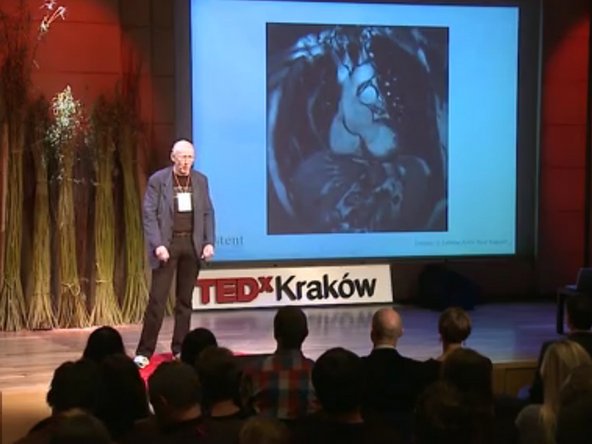
Few people have the courage to challenge their doctors. Fewer have the courage (and skills) to design their own medical device. Tal’s story demonstrates the beauty of cross-disciplinary work. Sometimes, in a world of increasing specialization, it’s easy to lose sight of what experts in different fields have in common—whether you’re fixing pipes, fixing hearts, fixing computers, or fixing cars, you’re making complex integrated systems go.

Cross-disciplinary work is a struggle, Tal explains. Doctors and engineers have different jargon, different knowledge bases, and different egos—but when those challenges are overcome, the results can be phenomenal.

All the more reason for everyone to learn a bit of engineering by getting to know the insides of your own stuff.

Comments

I was delighted to encounter this video. My father was a Vascular surgeon who (in the early 1950′s) followed his curiosity about how the human body seemed to accept a new suturing thread (Vinon X) in the course of performing a new, still experimental surgical procedure of creating a bypass shunt around a diseased liver using veins (harvested from elsewhere it the patient). His discovery was that the body attached the same cell tissue coating, to the new surgical threads at the splice connection as normally lines the inner blood vessel walls. From this observation, he reasoned that a fabric of the same thread could be sewn into a tube of the right dimension and could be used to create the bypass blood vessel; or for that matter, could replace any damaged section of artery or vein. The first artificial blood vessels were custom made using my mother’s sewing machine set up in the gallery adjoining the operating room. then sterilized in an autoclave, and then sewn into the patient. He was always looking for better less invasive technique in his approach to medicine. I am even surprised that because he was also no stranger to the late night emergency repair of burst water pipes at home, that he did not also come up with a similar strategy to wrap vascular aneurisms. (An aneurism is the bulging failure of an arterial wall that eventually will rupture and hemorrhage causing death in a very short time!)
Nevertheless, Dr. Arthur Voorhees had a great respect for problem solving ingenuity, teamwork, and collaboration; and I suspect he would have been excited and delighted by this example of thinking outside the box especially with the patient’s active participation in the concept, the design, and the outcome.

By: Stephen Voorhees - April 21, 2012 at 8:55 pm

I would love to contact Mr. Golsworthy to get his advice on my daughter’s heart condition. We are willing to fund the research but want it to happen quicker than the typical medical research cycle. Would really appreciate his contact info. Thanks, Laura

By: Laura Moorman - August 7, 2012 at 2:20 pm

Comments are closed