Necessary Accessories

Posted on: March 3, 2012 at 9:17am — By: Elizabeth

Right outside the Ghana electronics scrapyard Agbogbloshie, our car was approached by a young man selling refurbished TV remotes. In the developing world, entrepreneurs often start small one-person businesses, hawking available goods to passersby. Near Agbogbloshie, “available goods” means electronics and accessories for those electronics. What good is a TV without a remote? What good is a printer without a power adapter?
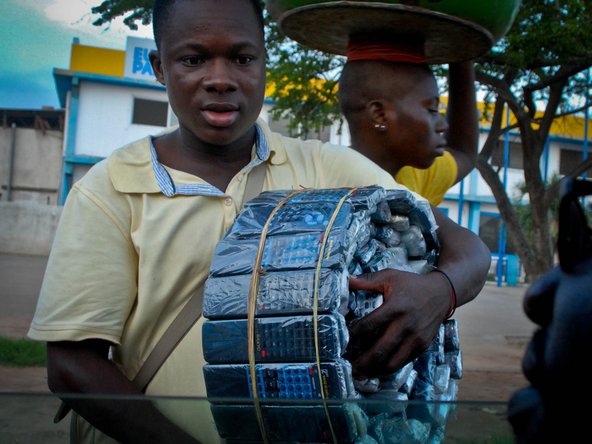
This is a side of Agbogbloshie you don’t see as often as pictures of young boys burning electronics. Many jobs are born out of those piles of discarded electronics—this man had to collect these remotes, repair and clean them, and now he can put food on the table by selling them. Is Agbogbloshie just a dump? Clearly some of the electronics that end up there are functional, or at least repairable. Stopping all exports of used electronic equipment would mean this man would lose his job. And at one level, it’s pretty good job: it requires electronics repair skill and business sense. Isn’t it better that these remotes be reused than shredded?

However, he’s also likely exposed to all kinds of toxic fumes from the fires in the scrapyard. If the arsenic he’s breathing gives him lung cancer, or the lead causes nerve damage, was it worth it? One thing is clear—Africa desperately needs better modern e-waste recycling infrastructure. Until then, a vast repair- and tech-savvy workforce will continue to sicken itself with toxins.

Comments

To my knowledge, there is no correlation with serious toxics exposure and electronics repair. The toxics in the bloodstream from sites like Guiyu China appear to come from burning lead-insulated wire, which is usually heavy cable (like 3-phase and 4-phase current wire). The arsenic in the river in Guiyu appears to come from a textile mill upstream (same as the source of arsenic in other world pollution sites – textile dying is ugly).

We certainly want people to be safe, but want to avoid exaggerating the exposure that a kid like this is exposed to. I mean, if you know otherwise, please educate me, but if a hospital has a bad bone X-ray machine, you don’t close the emergency room. Let’s be specific on the processes with risks and keep them separated from the recycling and repair processes (such as dismantling) which don’t appear to have such risks associated with them. Unless the kid is chewing on 1970s wire, that’s a bad habit too. http://www.cdc.gov/mmwr/preview/mmwrhtml/00020984.htm

By: Robin Ingenthron (@WR3A) - March 4, 2012 at 3:20 pm

Open burning is pretty hard to escape in Agbogbloshie—even if this young man isn’t directly involved in open burning, if he’s hanging around the scrapyard hunting for TV remotes, he’s likely breathing in much of the same noxious stuff.

I absolutely didn’t mean to imply that repair is toxic; my apologies if it seemed that way.

I didn’t realize that claims of arsenic e-waste toxicity came primarily from studies of Guiyu, or that those results may reflect pollution from other sources. There is so much conflicting information; I’m still working to learn what to trust. I appreciate the fact-checking, as always, Robin.

Re: toxics exposure at Agbogbloshie, there is a Basel Secretariat report (from a Green Advocacy Ghana, EPA Ghana, and EMPA Switzerland study) that found dangerous levels of heavy metals and PCBs in Agbogbloshie soil samples:

The two soils and ashes samples with the highest contamination (GH8002 & 3), taken at burning sites in Agbogbloshie showed copper, lead, tin and zinc concentrations over one hundred times higher than typical background levels. Concentrations of antimony and cadmium exceeded typical background soil levels by 72 around fifty times for antimony and five times for cadmium. [...] In addition to heavy metals, the samples also contained organic chemicals such as halogenated chemicals (e.g. polybrominated diphenyl ethers (PBDEs), used as flame retardants, especially in monitor and TV casings) and polychlorinated biphenyls (PCBs, often found in old condensers) as well as phthalates (commonly used as plasticizers in flexible PVC). The burning of PVC, in addition to release chemical additives including heavy metals and phthalates, can generate many organic chemicals itself. Dioxins and furans (PCDD/F) are formed as products of incomplete combustion of chlorinated organic materials, including PVC coated wires, with the reaction being catalysed by the presence of metals such as copper. This process can disperse fine ashes containing PCDD/Fs to areas surrounding burning sites, leading to contamination of surface soils and dusts (Bridgen et al. 2008).

Of course, the report also offers the very encouraging news that 57% of obsolete devices generated in Ghana in 2009 were repaired—what an awesome example for the rest of the world!

By: Elizabeth - March 6, 2012 at 5:01 pm

Very interesting story, at least they are electronically inclined! Wait does that exist ?

By: Kelly - March 7, 2012 at 2:01 am

Comments are closed